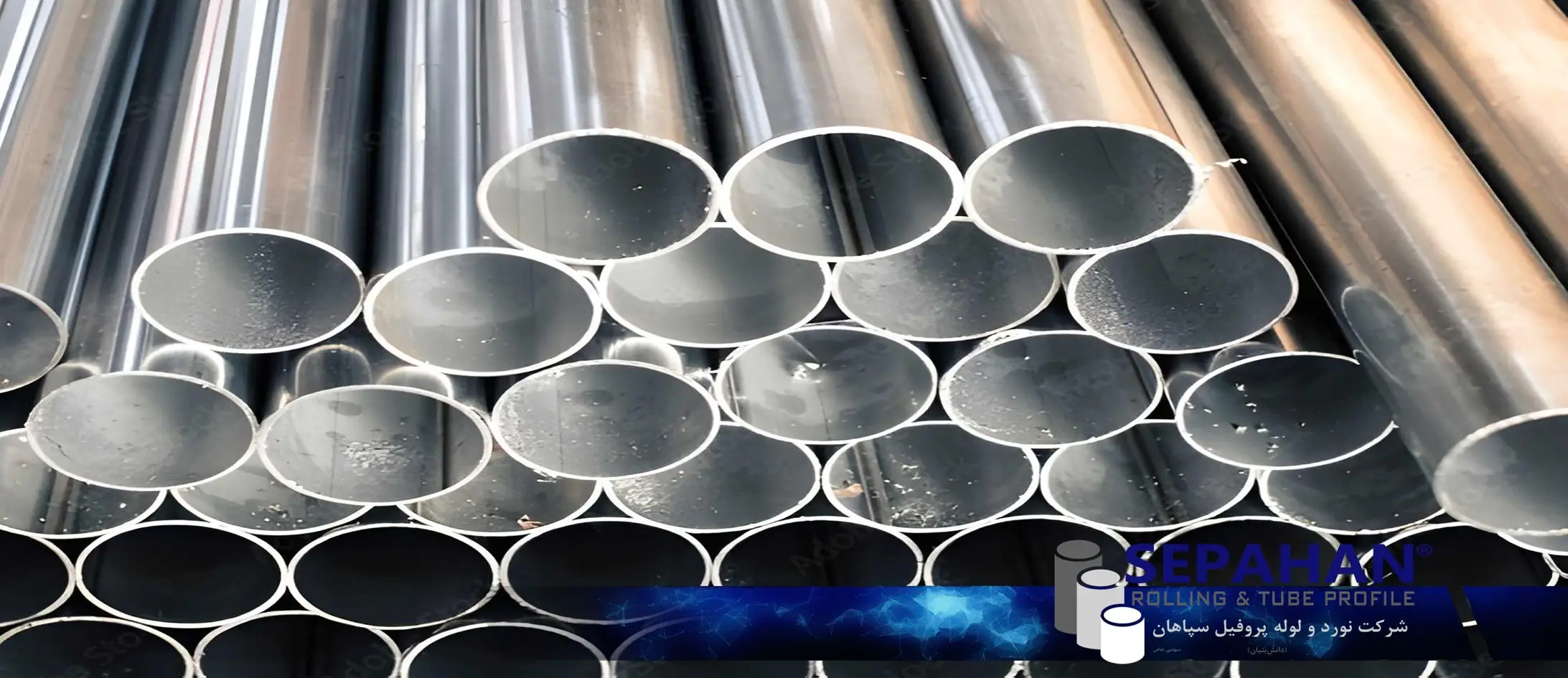
heat exchanger
Heat exchanger is a system for transferring heat between two or more fluids (liquid/gas). In fact, heat exchangers are used in both cooling and heating processes. The flowing fluids in the exchangers are separated from each other by a solid wall, mainly to prevent mixing, and of course, in certain types of heat exchangers, it is also possible for the fluid streams to be in direct contact with each other.
Product Specifications :
- Code:24
- Status:موجود
- Category:تیوب درز مخفی
Types of heat exchangers Heat exchangers can be classified into three groups of low pressure, medium pressure and high pressure according to the fluid working pressure. However, the types of heat exchangers are often examined based on their design structure, which are: Double pipe heat exchanger:The simplest exchangers used in the industry are double tubular heat exchangers, which are also called tubular exchangers for short. On the one hand, the cheapness of these converters, both in terms of design and maintenance, has made them a good choice for small industries, and on the other hand, their low efficiency as well as occupying a lot of space in the scales large, has caused them to be less used in today's modern industriesAnd more efficient converters such as shell and tube converters and plate converters should be used. The structure of a tubular heat exchanger, in its simplest form, consists of two tubes with different diameters, the smaller tube being placed concentrically inside the other tube. As one of the fluids flows in the smaller tube and the other fluid flows in the annular space between the two tubes.In fact, it is the inner tube wall that forms the heat transfer surface and is often finned to achieve more surface area. In the design of these converters, one of the important factors is the type of flow pattern in the converter. A tubular heat exchanger can usually be designed for both Counter Flow and Parallel Flow patterns.But the orthogonal flow pattern (Cross Flow) does not work in such a converter. One of the advantages of tubular heat exchangers is their correct operation under conditions of opposite flow pattern. The model that has the highest efficiency and the highest heat transfer coefficient (U Factor) in the design of tubular exchangers. Tubular exchangers are suitable for applications where either the flow rate of passing fluids is low and large temperature changes are expected, or a small heat transfer is required for a large flow rate.Of course, considering the dimensions of tube converters, it will be logical to use them in conditions where there is enough space. It is worth mentioning that in order to create more capacities, several tubular converter units can be installed vertically in series or parallel to each other. Tubular heat exchangers are most widely used in the food and air conditioning industries (as boilers, evaporators, or condensers). Shell and tube heat exchanger:One of the most common types of exchangers in various industries, including air conditioning and industrial refrigeration, is the shell and tube heat exchanger. As the name suggests, these converters consist of a number of tubes that are placed inside a cylindrical shell.Two fluid streams with different initial temperatures enter the converter. One passes inside the tubes and the other passes through the shell (outside the tubes). Heat is transferred between two fluids through the walls of the tubes, sometimes from the fluid inside the tube to the fluid flowing in the shell and sometimes vice versa.
Similar Products
Recommended Products


Rubber-Metal Composite Components
Metal-plastic composite components are widely used in automobiles due to advantages such as lower weight, reduced noise and vibration, and lower production costs. In this context, steel tubes, as one of the main components of these parts, play a very important role.
Technical Specifications



Superheaters
Superheater tubes are vital components in power plants, particularly in boiler systems, where they play a fundamental role in increasing the temperature of steam before it enters the turbine. Several types of superheater tubes with specific characteristics are used in power plants to meet different operating conditions.
Technical Specifications